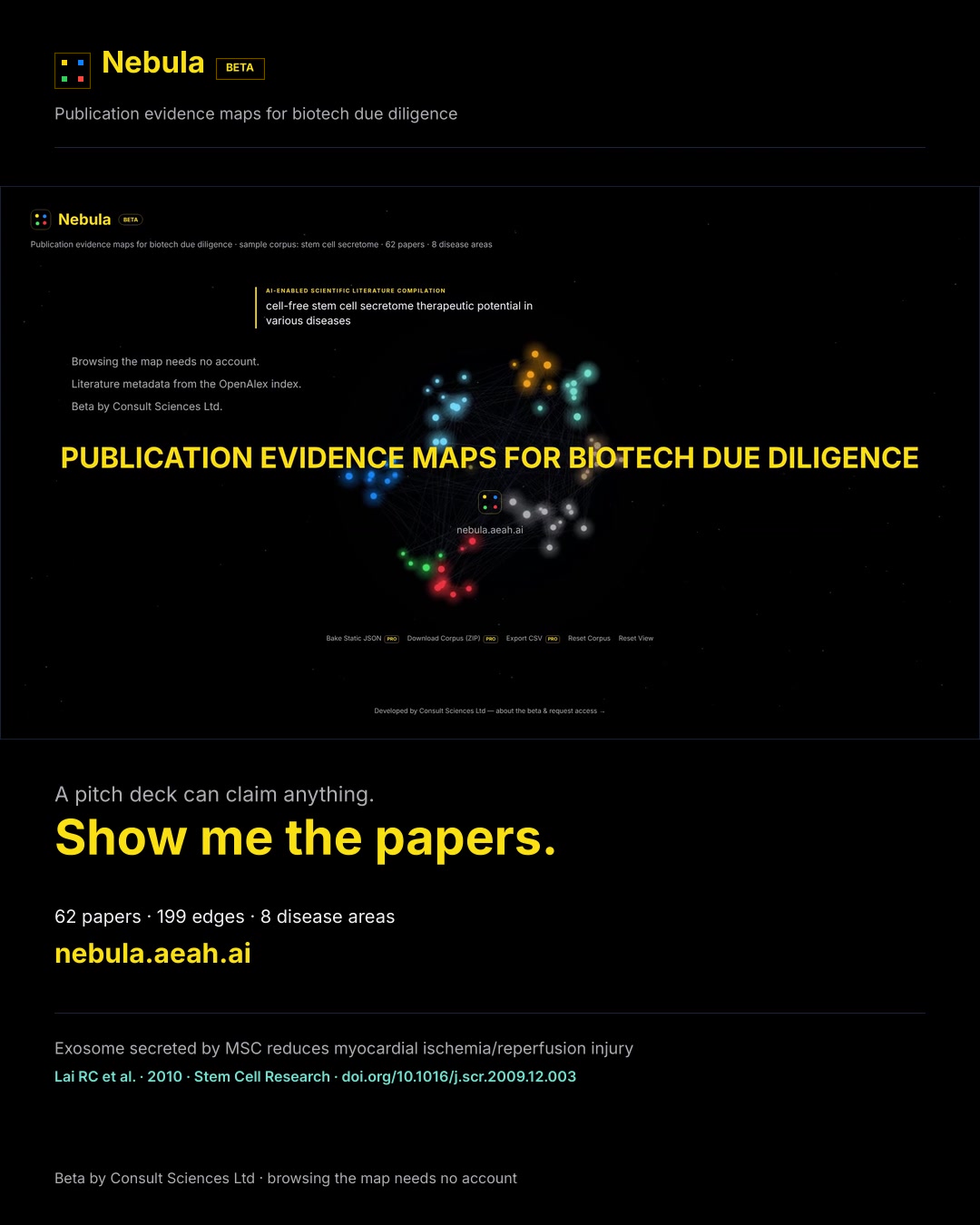
A pitch deck can claim anything.Show me the papers.
Nebula maps the peer-reviewed evidence behind a biotech claim. Every glowing node is a real
publication you can open — citation, journal and DOI included — clustered by disease area, so
you can see what the science actually supports.
19.4s · h264 + aac · poster baked as frame 0
sample corpus: stem cell secretome
62 papers · 199 edges · 8 disease areas
Two cuts, one story
Identical edit, audio and timing. Use 4:5 for LinkedIn’s mobile feed — it occupies more
vertical space, so it holds attention longer — and 16:9 for a desktop feed or YouTube.
4:5 — LinkedIn feed (recommended)
1080×1350 · 30 fps · 1.5 MB
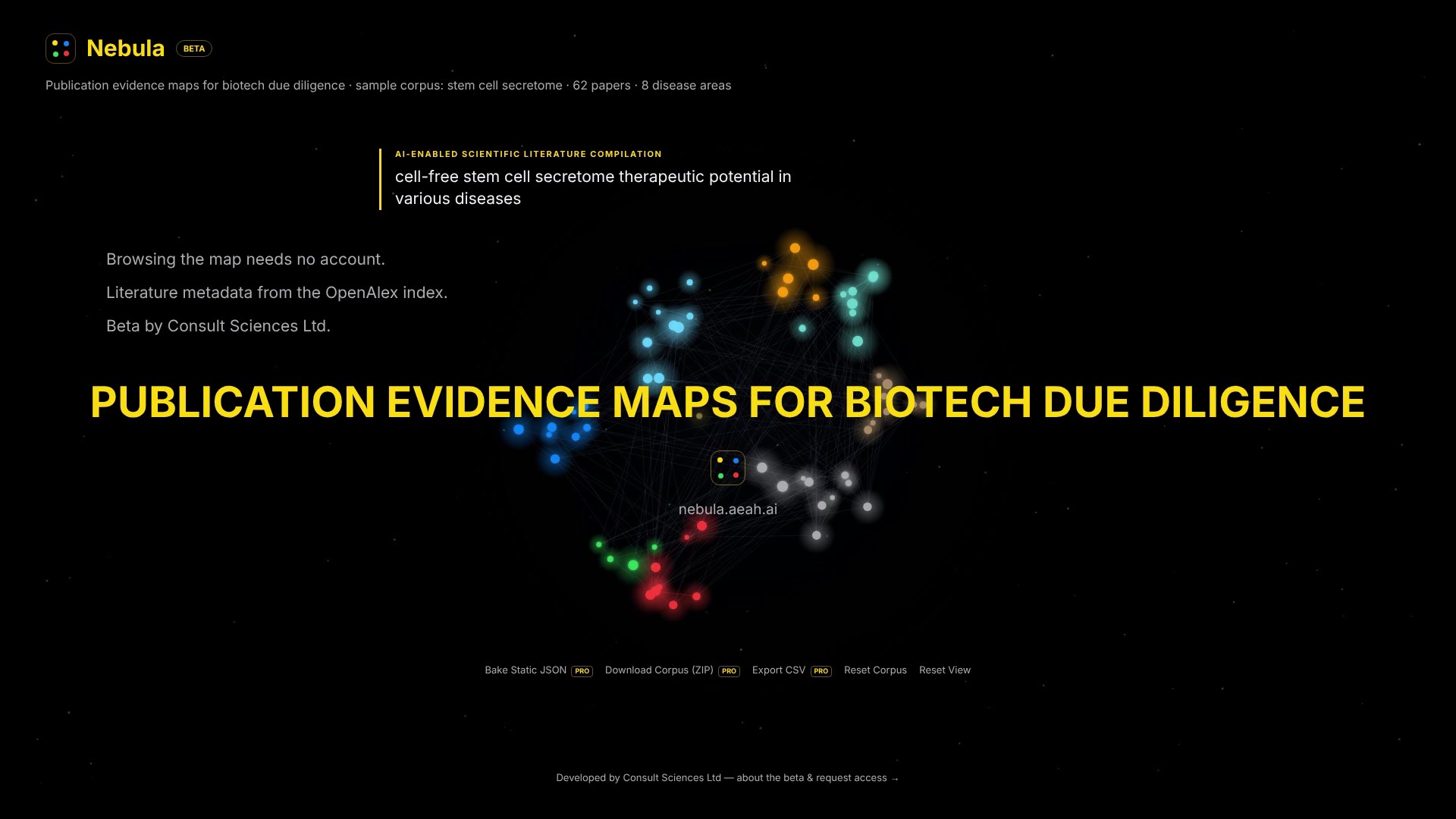
16:9 — landscape
1920×1080 · 30 fps · 3.4 MB
Post copy
A pitch deck can claim anything. Nebula maps the peer-reviewed evidence behind the claim — 62 studies, 8 disease areas, every glowing node a real paper you can open. Beta at nebula.aeah.ai
What the video shows
- Hook (0–4s) — “A pitch deck can claim anything.” → “Show me the papers.”
- The map assembles (4–9.4s) — the real UI: chrome, topic banner, prompt box and PRO export controls; eight disease-area clusters land one by one and the counters tick to 62 papers / 199 edges.
- Click a node (9.4–14.4s) — a real citation opens: Exosome secreted by MSC reduces myocardial ischemia/reperfusion injury (Lai RC et al., 2010, Stem Cell Research), then a COVID-19 trial — each with its DOI.
- Outro (14.4–19.4s) — no account needed to browse; metadata from the OpenAlex index; beta by Consult Sciences Ltd.
Provenance of the figures on screen
- 62 papers / 8 disease areas — the app’s own embedded corpus (cluster sizes 10, 8, 4, 8, 10, 6, 8, 8).
- 199 edges — asserted by the running app’s own counter, matching the rendered graph.
- Citations — quoted verbatim from the app’s corpus, not paraphrased.