A dossier, not a summary.
Curebiology reads seven biomedical registries live — PubMed, ClinicalTrials.gov, openFDA,
Open Targets, ChEMBL, PubChem and EPO patents — and writes a cited diligence dossier for one
asset: six grounded scores, a memorandum, historical analogs, the patent space and the failure
modes that killed neighbouring programmes.
16.0s · h264 · 20 fps
demo run: osimertinib × non-small cell lung cancer
297 EPO publications · 3,200 PubMed hits · 340 trials
Two cuts, one story
Identical edit and timing. Use 4:5 for the LinkedIn mobile feed — it holds more
vertical space — and 16:9 for a desktop feed or YouTube.
4:5 — LinkedIn feed (recommended)
1080×1350 · 20 fps · 1.3 MB
16:9 — landscape
1920×1080 · 20 fps · 1.9 MB
Post copy
A dossier, not a summary. Curebiology reads seven biomedical registries live and writes one cited diligence document: six grounded scores, the memorandum a committee reads first, historical analogs, the patent space and the failure modes that killed neighbouring programmes. $199/month at curebiology.com
What the video shows
- Hook (0–2.5s) — “A dossier, not a summary.” · seven registries read live
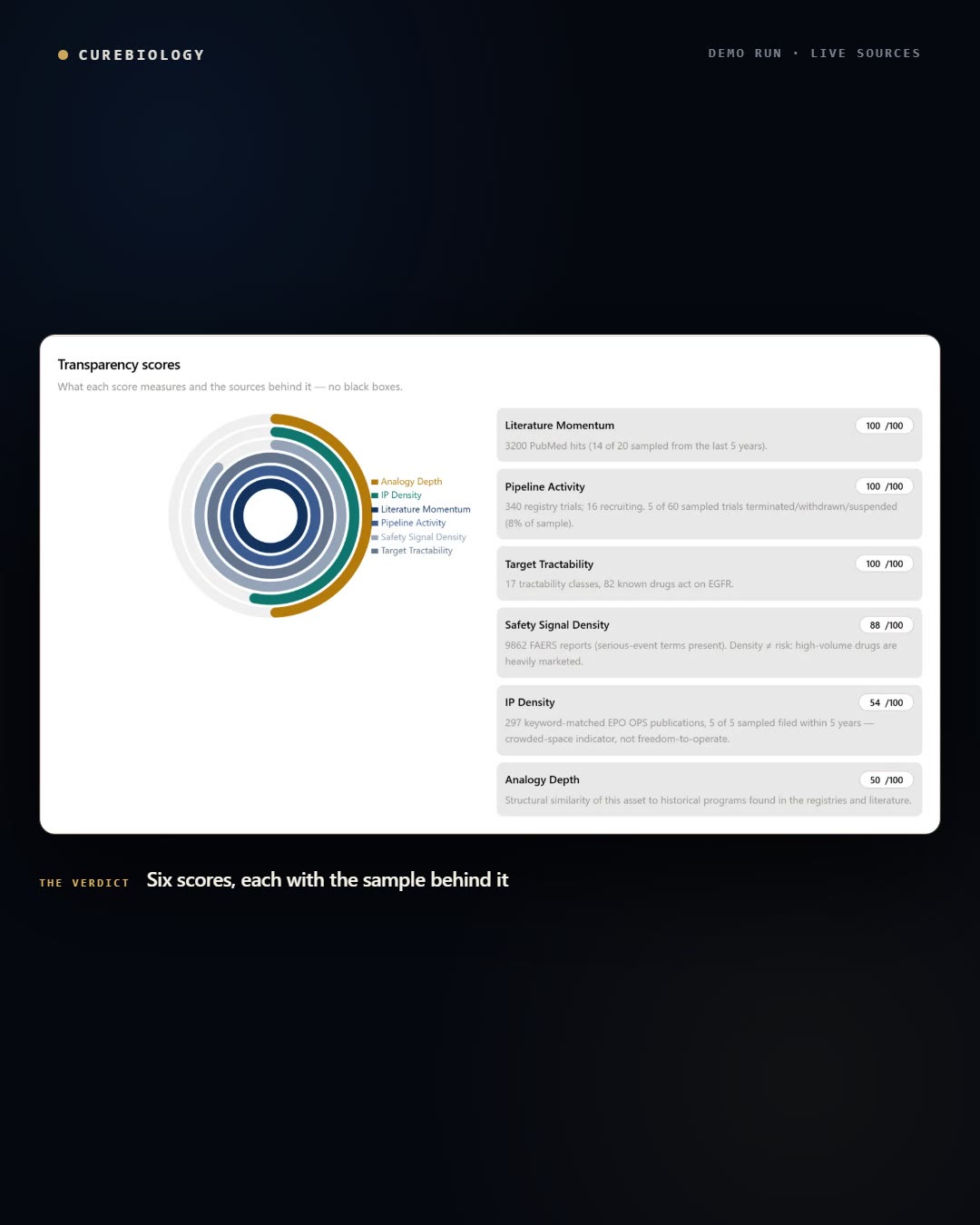
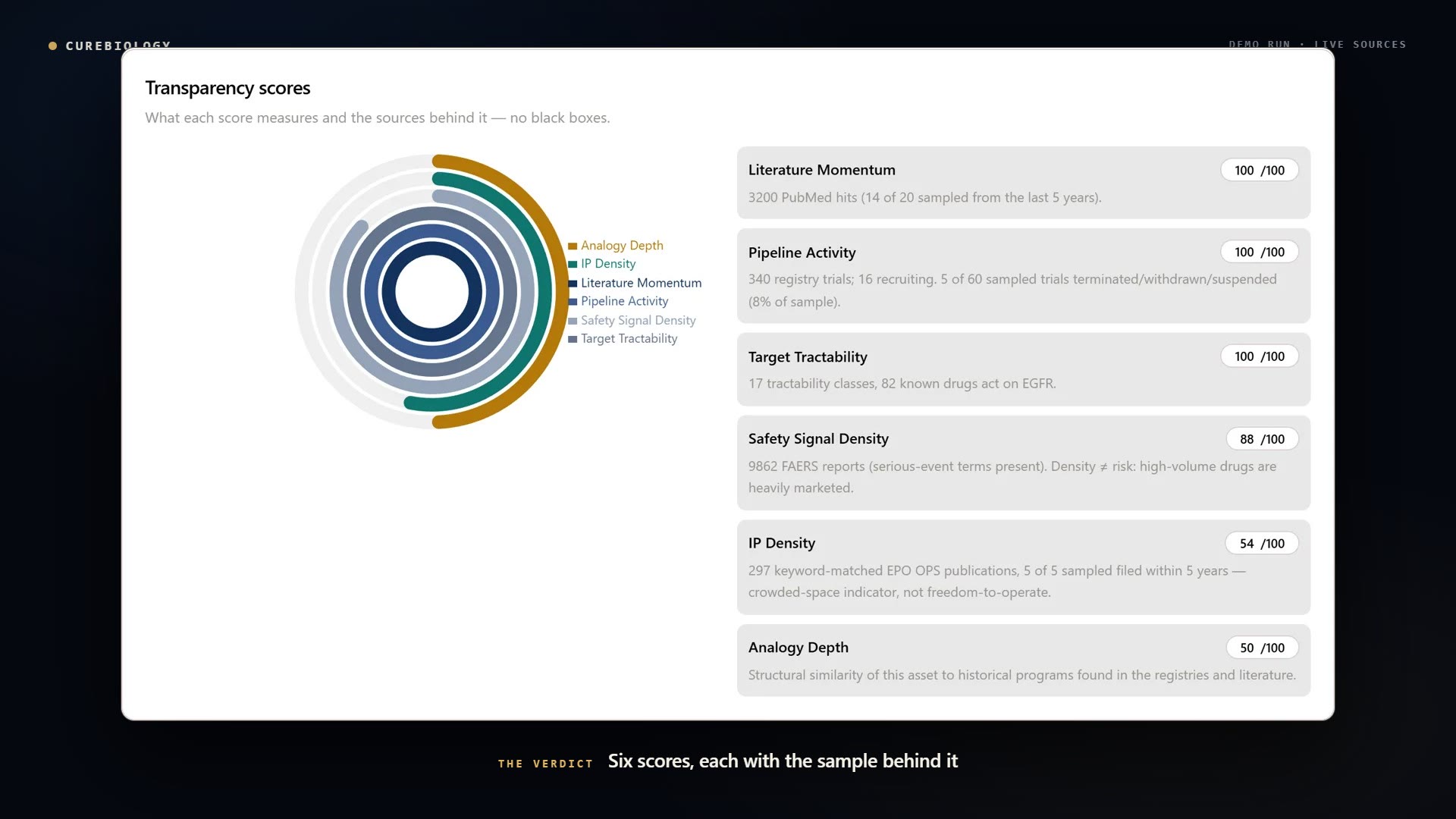
- 2.5–6.2s — the verdict: six scores, each naming the sample behind it
- 6.2–10.0s — the memorandum: target validation, translatability, trial feasibility, safety clearance, and the most critical risk
- 10.0–13.7s — the risk map: seven failure modes, ranked and sourced
- 13.7–16.0s — $199/month · curebiology.com
Every number in the frames comes from the run itself: 297 EPO publications matched with five read
in full, 3,200 PubMed hits, 340 registry trials. Nothing in the video is a mock-up — the
screens are captures of the signed-in report view.